Saturday, June 14, 2014

Grassland Gardening in Pictures

Because I'm too tired to write anything much.

Three sisters are coming along. I am growing my favorite, Cherokee white flour corn (makes the fluffiest cornbread without additional flour), and this time I let the corn get a head start over the beans. They got a bit out of hand last year. The beans have just popped up and are growing from seeds I've saved for the past few years of a variety called Selma Zesta, a native rattlesnake heirloom bean developed not far from here in Newberry, SC. It produces loads of tender pods, even when large, and the beans can be dried as well. The pumpkins have also just come up, and are a variety saved for the past few years from a volunteer that grew out of the compost pile.

The rabbit tractor can be seen in the back, and this is moved up and down the rows to control weeds. (More weed control is planned by extending the chicken run from the lower garden to include wire chicken tunnels, or "chunnels" around much of the perimeter of the upper terrace.) The rabbits also tractored over the beds and grazed a little on the rye growing during the winter, after which the rye was left to grow to the pollen stage before being cut down with a sickle. It was then left to decompose for two weeks before the corn was planted. Rye develops a vast root system and as this breaks down, it leaves organic matter and channels in the soil for the roots of the following crops. A small bundle (too small, methinks) of rye is left standing for the seeds to ripen and be collected for next fall. Sweet potatoes are planted at it's base, so food can still be grown in the space. Lettuce, buckwheat, loads of sweet potatoes and tomatoes (that desperately need staking!) are more crops being grown in the upper garden shown here.
Snowflake and Cupcake enjoy weeds and things from the lower garden. Spent lettuce, wood sorrel (aka "lemony hearts") violet greens, johnny jump ups, dandelion, plantain, and grass, too much grass. There is plenty to keep them well fed without additional feed at this time. Some of the grass dries into hay during the hot days and this gives them something tough to nibble on to work their teeth down, along with occasional twigs.
Meanwhile, in the lower garden, a bumblebee enjoys some lavender blooms.


Gobs of ripening blueberries attract daily grazers...
...including three young boys I know.


And a formerly unmanageable thicket outside the garden fence has been graciously defoliated....
...by some rather obliging ruminants.


Wednesday, January 15, 2014

Prophetic Patterning Part 2

In my last post, I touched briefly on the concept of patterns over time. I have begun the practice of regarding things, not only as they appear now, but as they once were, and what they could become. Imagining a landscape like this, what shaped it, how each thing grew on it, it's place on this spinning planet, this solar system, this galaxy, this universe, can aid in the design process.

Everything spirals. There really are no straight lines when viewed from an is-was-will-be perspective.

A tree spirals down, following gravity, toward the center of the earth. It spirals out following the sun. Because it interacts and reacts with the various media of atmosphere and soil, it branches out at regular, spiraling intervals, following the pattern most suited to reaching it's destination. Other events occurring over time can interrupt these patterns and cause irregularities. The roots may hit a rock, and have to navigate around them. A falling tree nearby might lop off several branches. A year of plentiful rain may cause a burst in growth speed, and so on. These events add up to the story of that particular tree, making it an individual apart from all others. Thus patterns plus stories together are needed to learn the ways of a landscape.
Double spirals also exist on composite flower heads, like this chamomile

When wind hits your face, it's not coming at you in a straight line, but from an arc. Weather occurs in spirals- cyclones and anticyclones around centers of low or high pressure, respectively. Water, when given it's way, as in a vertical drop in a drain, spirals down. It is not seeking the sea, but the center of the earth. The sea is just where it goes because it cannot get there. It starts as many branches, joins into one river, and again branches out into deltas and estuaries.

The muscles in our bodies, that operate the organs that keep us alive operate in a spiraling, peristaltic motion, and the vessels that carry supplies and information to all parts branch into smaller and smaller fractals.

Spirals and fractals, over time and in space, are the key to pattern understanding. How important to the permaculturalist is pattern understanding? I'll let Bill Mollison answer that.

"An understanding (even a partial understanding) of the underlying patterns that link all phenomena creates a powerful abstract tool for designers. At any point in the design process, appropriate patterning can assist the achievement of a sustainable yield from flows, growth forms, or information flux. Patterns imposed on constructs in domestic or village assemblies can result in energy savings, and satisfactory aesthetics and function, while sustaining those organisms inhabiting the designed habitat.

Patterning is the way we frame our designs, the template into which we fit the information, entities and objects assembled from observation, map overlays, the analytic divination of connections, and the selection of specific materials and technologies. It is this patterning that permits our elements to flow and function in beneficial relationships. The pattern is design, and design is the subject of permaculture." (from Permaculture: A Designer's Manual,, bold emphasis, mine)

Again, how to apply this practically? Directing and dispersing water evenly throughout the landscape is the first task of the designer. Water is the movement of life through the whole system, and it carries dissolved nutrients from rocks, plant and animal detritus along with it. An overlay of a spiral, or even the sunflower's double spiral, could be placed over a map of the landscape with the center at the lowest point. A computer graphic program could allow the lines of the spiral to be skewed to fit the contour lines. This would make it easier to map the progress of the water, and to place swales, berms, pond, rain gardens, culverts, and drains to either slow and spread to hydrate the landscape or concentrate the flow to drain or to operate a ram pump or water mill. The lines of the spiral would be the guide, parallel to which elements would be placed to arrest the flow, while cross cut branchings would concentrate and/or disperse it. The shape of the counter arcs from the double spiral, where they intersect from the clockwise spiral, might make a good shape for a berm designed to slow an erosive stream of water and deflect it partially uphill (a shape like a curvy check mark).
TreeYo Permaculture
 What about plant placement? The flowers that become seeds in the composite flowers like sunflowers, are packed in such a way that the most seeds possible can exist in the smallest possible space. Why not use this pattern, instead of planting in rows, to arrange plants in a bed, and again, using keyhole shaped paths along the arcs of the double spiral as efficient access points?

I am not going to pretend that I am positive any of these ideas will actually work, but they do present an area to experiment with and to put to use an understanding of the patterns that are self similar throughout an array of phenomena. But there are far more pressing issues that call for a recasting of our ways of seeing things...

I mentioned in my previous post that I was going to be on the lookout for art forms that displayed this time- and-space-in-flux-quality of vision. I was not expecting the form that it would take. The horror and shock and senseless cruelty of the deed, coupled with the artist's image of the child inside the grown man calling for his father reveals our blindness and failure to see people not as frozen objects in time, but as they were-are-could-be should they have had the chance. (I had to wait until I got to the shower so the kids would not hear my reaction, so if you are sensitive to depictions of violence, please be careful before viewing the image below.) In any case, it is a reminder to me just what I am here for, and why I have chosen permaculture as the most practical course for achieving a better world where this kind of fucking shit is not tolerated.

Part 1


Tuesday, January 14, 2014

Prophetic Patterning Part 1

Amidst the unusually cold temperatures, sandwiched between long periods of heavy rainfall, I have been spending a considerable amount of time indoors near the warmth of the wood stove.  Winter is a good time to catch up on studies, and I've taken the opportunity to read and study more of Bill Mollison's Permaculture: A Designer's Manual. I had originally borrowed a copy from a friend, then after returning it, have been using a PDF copy I had downloaded some time ago. I still have not finished it, it is so densely packed with technical information, charts, illustrations, Mollison's intuitive creativity, all packaged together in a strange mix of science and ancient, indigenous wisdom.

The subject that so far has been most difficult for me to grasp is that of "Patterns". It has never been clear to me, even after completing my PDC and listening to and reading numerous other permaculture practitioners, how exactly to translate the theory into practical applications. Other than increasing edge by using branches and crenellations instead of straight lines (because more energy is exchanged, more diversity and activity occurs where two edges meet), or simply copying shapes found in Nature, like spirals, because we are supposed to copy Nature, etc., etc., I was not comprehending the significance, the science and intuition, which I felt must be there. There was something more, something amazing, massive, a veritable frontier of possibility, but finding a trail through such a wilderness was daunting and confusing.
photo by TreeYo Permaculture
So I climbed up Mt. Sinai to sit again at the guru's feet, and like Moses, was enfolded in a cloud of contemplation. The experience bordered on the ecstatic. I caught a glimpse, as it were, of the universe inside Mollison's mind. I was drawn to contemplate everything at once, and felt the dizzying, spiraling of time and space contained inside and folding in and in upon itself and out and out everywhere, all in one place at one time, all times, forever expanding and always contained in the smallest seed.

"Everything gardens." was his phrase to relay how everything plays a part in the whole of life. "Everything is story." was the theme of my first and recent presentation on design process and landscape literacy. But that experience, and the role of patterns in permaculture and life in general, perhaps could best be contained in the words, "Everything dances." Indeed, it is exactly this, the ecstatic, ancient concept of perichoresis, the interconnected dance of all things, and the deep, deep longing, sorrowful and joyful, of the world that could be. The world we groan to give birth to, hoping against odds, against the walls and weapons and flags that divide us, the fences and prickly hedges and the fear of touching one another....

....But I am exhausted mentally, and ready to climb down and enjoy the simple things. I hope to not simply be a collector of exotic intellectual experiences, but to plunge my hands into warm, spring soil, and eat what it gives me. Soon, I hope. The cold and wet cannot last forever. In the mean time, I have thought of a few interesting applications to all this pattern stuff. I'm hoping to be part of a pattern renaissance of sorts, where the application of such things is both a way to increase yield and an art form, at the same time, together in a mutually beneficial, boosting process.

To begin with, a little history.


But although these patterns are observed and found in Nature, they are never perfect, only approximate. And this is important to keep in mind. Mollison writes, "A bird's-eye view of centralised and disempowered societies will reveal a strictly rectilinear network of streets, farms, and property boundaries. It is as though we have patterned the earth to suit our survey instruments rather than to serve human or environmental needs. We cannot perhaps blame Euclid for this, but we can blame his followers. The straight-line patterns that result prevent most sensible landscape planning strategies and result in neither an aesthetically nor functionally satisfactory landscape or streetscape." Euclidean geometry has been a tool of empires, pyramids, forced patterns, social stratifications and the elitism that seeks to purge and purify uncleanness and irregularity. We can look back in history to see where that leads. The theologian, Walter Brueggemann, in The Prophetic Imagination calls this "the royal consciousness".*

This next special picks up where the last one leaves off, with Benoit Mandelbrot's game changing discoveries of fractals.

How can this be applied to permaculture? I think the key is proportion. Everything, the universe included, is assembled into general proportions which are self similar all the way down to the tiniest bits. These proportions are also patterns in time. Everything that grows or expands branches out again and again at regular intervals and appropriate times.

Along with proportion is the lowly and beautiful ideal of prudence. Not prudishly prudent, but a balanced existence based upon one's space in the world, and the spaces built around that which are no more and no less than what is required to live a full and healthy life. This can apply to individuals, their homes, and human villages. There is a lovely proportion, a golden ratio, that can be a guide to determining prudent sizes and spaces.

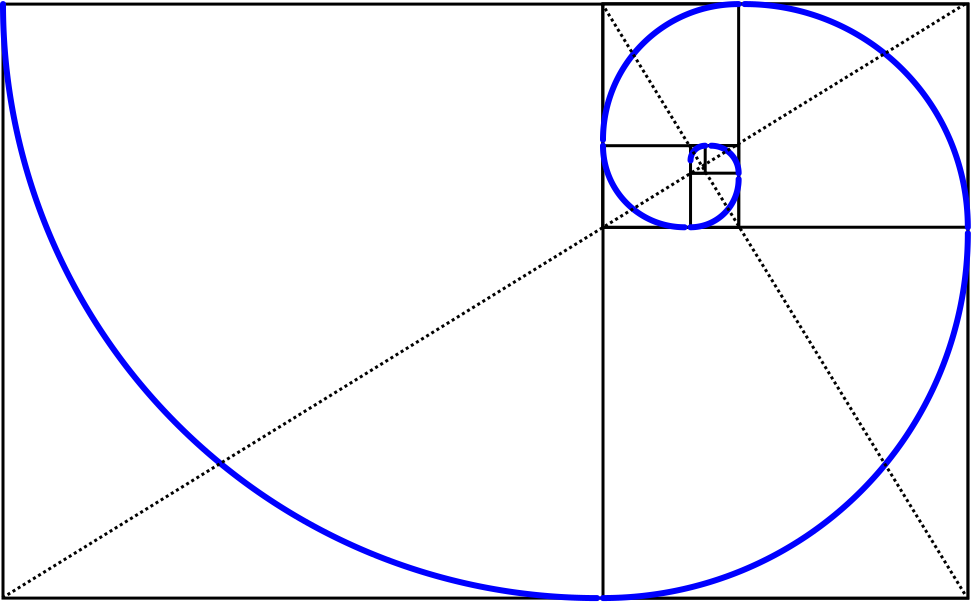
One particularly lovely shape that is highly valued in permaculture design is a spiral. The spiral of a nautilus, as was seen in the first video, generally follows a Fibonacci sequence and the golden spiral in its' growth pattern.

photo by Chris73

The diagram below reveals how this is the case. 

graphic by Luiz Real

A practical application that comes to mind, is in the permaculture concept of zones. Zones are a method in permaculture design of assembling elements (gardens, livestock, orchards, woodlots) according to the frequency of visits needed to care for them. So zone 1 is right outside the kitchen door and contains the kitchen garden, maybe a poultry area bordering that, while zone 2 is for larger gardens, livestock, etc. that require slightly fewer frequencies of visits, and so on. The proportions of the golden rectangles forming the spiral, then, could become a guide for arranging these zones, the spiral itself cutting a gentle, flowing path through the whole farm or garden. Then, as in the shell above, the areas closest to the origin would be more intensively managed and could be intersected by secondary arc-like walkways. Add in some branching keyhole shaped path endings, and more planting areas could be accessed without sacrificing as much growing space to walkways.

What about plant placement? As in the documentary above, natural plant communities, like rainforests, reflect the same, descending order, both in their branching patterns and in the distribution and frequency of their sizes. So when we assemble our guilds (more about them here), instead of just using units of measurement, we could experiment with using proportions from Nature. 

The possibilities are virtually limitless. But I think the key to connecting theory to practice is the concept of prudent proportion, both for maximum efficiency of energy exchange and use, as well as maximum aesthetics. I am walking around now, eyes wide open, all senses, all nerves alert, to recognize and delight in the unfolding of this new frontier in design, wherever it may surface.

Good soil and peaceful proportions to you all!


*For a liberating treatment of the Bible as a struggle between the religion of creation and the religion of empire, see Wes Howard-Brooks' Come Out, My People.

Thursday, October 24, 2013

Last of the Harvest

Final harvest of the year.
 (l to r: peanuts, drying pole beans, sweet potatoes, pumpkins and southern peas)

Wendy the sheep is happy to clean up after the harvest, and maybe leave a little fertilizer too!

Smiling, as usual. Every new thing in the garden makes him laugh- shiny seeds hiding in wrinkled cases, pots with dirt to dump and spread, scratching chickens and munching sheep.

Wednesday, October 9, 2013

Good Eats to Keep

 Fall is getting on and with it a ripe harvest of the 'keepers', pantry stock that stores just as it is.

Pumpkins, gourdseed corn, southern peas and a sneak peek of the sweet potatoes to come.

                                     And here are my three sweet pea shelling sons!

Monday, June 10, 2013

Spring Harvest and Summer Plantings


   It has been a very busy spring leaving little time for blogging. The cool weather stayed on well into May, and pushed the main season crop planting about a month later than usual. In some places, like the beds of winter wheat above, I had to wait for the sun's ripening heat to harvest the over wintering cover crops, or, in the case of rye, the grain heads to go into the pollen stage to chop them into mulch. In others, the ground was simply not warm enough for the spring veggies to take off. But this weather has been great for greens. We have been enjoying daily salads and the main bulk of our lettuce has not even been harvested yet. We are going to have to find someone to share it with, because with temps climbing into the 90's this week, it's going to bolt really fast.

After a winter cover of cereal rye and hairy vetch are cut down into mulch and decomposed for a couple weeks, my Three Sisters beds are planted. Here is Cherokee white flour corn, Selma Zesta pole beans and Princess pumpkins, all planted from seeds saved the previous year.
  Managing a continuous garden can have unforeseen challenges. I like to try new things and it is easy to lose focus and get sidetracked. For instance, I had bought some discounted organic potatoes from the grocery store and decided to plant some in my garden when they started to sprout in early spring. They were doing very well, until heavy rains and warm weather brought the first signs of early blight on a couple plants. I fixed a horsetail tea spray, and this seemed to halt the spread temporarily. But as the spring continued, I realized that I was going to have to baby these plants with regular applications if I wanted a mature crop. So I decided to go ahead and harvest them as new potatoes and plant my relatively care free specialty, the Three Sisters, in their place. The potatoes had broken up the soil nicely and the bed still had plenty of compost mulch that the soil had not finished "eating", plus the leaves and stems of the potato plants that were returned to it. And since the focus on my garden is on heirloom grains grown in polyculture, (there is currently no one at my local farmer's market selling this, so it is also a business goal) I decided to assign the potatoes the function of support crop, like a weed suppressing cover with the harvested new potatoes as icing on the cake. And that was some yummy icing! We ate them almost every day and they were gone in a week. Also, I do have a second bed of later planted potatoes growing with rye and vetch that seem to be escaping the blight, and three of the kids have some in their hugelkultur beds that were planted even later along with tansy. So we may end up with a good harvest, all from about $4 worth of discounted spuds. Here's to good eating- past, present and future!
Our anniversary breakfast made from our own hens' eggs and our homegrown new potatoes.


Friday, April 19, 2013

Love the Earth

Spring dandelion greens and crowns harvested from the garden.

Roasted dandelion root "coffee"

A hastily woven honeysuckle basket to bring up eggs, herbs and greens from the garden.

Omelets and salad for lunch!
The goal of Permaculture is, as my sister Marianne put it so well, to enable a landscape to take care of itself. That includes the humans on the landscape, who exist in partnership with the other residents. Each member provides not only for itself, but for the other members. This is done passively, but humans, of course, have the moral imperative to do it actively.                        

In Nature, there is no waste. Every "output" is another's "input", and no nutrients are lost. Rather, they are accumulated as biomass as long as the sun shines and there are tree leaves to photosynthesize. It is from this natural tendency toward abundance that we must track our existence, meeting our needs in a way that replenishes, rather than extracts and leaves compromised, denuded landscapes behind. Indeed, is it worth mining for minerals or fuel if it brings up salts and harsh metals, too much, too many at a time so that the land and water supplies are poisoned? Is it worth slashing the rainforest to grow cash crops for our addictive, high carb diets (and replacing the foraging diets of our livestock, too) if, after a couple seasons the rain washes away the topsoil, leaving bare places where nothing can grow? This can only be kept up for so long before there is nothing but desert, and no carbon sink. Or perhaps our worldview secretly gloats over the earth's destruction, and we think we will be among the holy, chosen few to drift above it all in pure, spiritual bliss if we just believe correctly. 

I have found that both the search for gold and the search for holiness are equally to be avoided, and both stem from a fear of some sort of death. The hero complex that sees Nature as "red in tooth and claw", the parochial patriotism to defend one's own against the constructed Other, and infuse it all with religious zeal...I hope to never walk that path again. Like Alyosha Karamazov, when his faith was in crisis, the expected miracle so long in coming, he remembers his mentor's words...to love the earth. And this is the only fiction to ever make me cry (I am not the sentimental type)- he falls to the ground and embraces and kisses the cold clay. Yes, clay. Here. It is what we are all made of. It is where constant miracles take place. Where seeds spring to life, the ancient Christian hope for our bodies. And this reverence for earth, for life, is the essence of truth in all religions and belief systems that contain it. Love the earth. 

"For God so loved the world..."

Thursday, March 14, 2013

Holy- you know what

Here are two piles of future fertility. Weed seedy pasture grasses are part of the mix, which just means more stuff for the chickens to eat that I don't have to plant or buy.

Yesterday I cleaned out both chicken houses in the backyard. We have a greatly reduced, older flock in the back of four hens and a rooster, but they still generate a significant amount of black and white gold, even with the deep litter method, to warrant the occasion. 

The deep litter method involves putting fresh bedding over all the richness until it's as deep as you want. The layers beneath slowly compost and can help keep the place warm in the winter. However, my stores have dried up and the weather has been so wet that it has not allowed enough time for our wealth of fallen leaves to dry enough to shred and bag up. And I wanted to get some cover and pasture crop growing around the fruit and nut trees planted in the chicken pen before they wake from their winter's dormancy.
After spreading my treasure around, I need to put up some protection from the chickens  before I sow the seeds.
The inexpensive netting is stretched between a few posts, pinned to the ground using snips of old fence wire, and extended to form baffles at the top with forked sticks and scraps of twine.


Now I can sow and water (gravity fed with the rainwater collection system I built on the nearby tractor shed last year)  safely while the chickens pace the perimeter in frustration. Yes, as soon as I started throwing down seed, the rooster came over and began chattering excitedly. The hens quickly joined him to see what the fuss was about. A good test for the net barrier, which did the trick.
A good afternoon's work. A blog post of euphemisms. Just wait until the coffee kicks in.....

Tuesday, March 5, 2013

Mobbing Along the Meadow

My day begins before dawn. I sip coffee and work on my computer stuff before the activity begins. The sun pops up and then the kids pop up, one at a time. There are breakfasts to get and lamb's milk to warm, and then, once the kids have dined, dressed and the baby diapered, it's time to do the chores.

First, the lambs are let out of their paddock and posts are driven in at the corners to secure it for the pigs.


Next, the pigs are let through to root in the paddock the lambs grazed in the day before.
Posts are driven in to secure the sides of the panels.
The three panels where the pigs used to be are moved to create a new paddock joined to the other one. Then the lambs follow their little mistress into their fresh grazing quarters.
The chicken tractor follows the general path of the sheep and pigs. It is moved to fresh ground on dry days. 


The tall, dead grass from last fall is cut a bit at a time with a sickle to provide fresh bedding for the animals, though enough is left standing to give the chickens plenty of hiding places from hawks.


The spent bedding is spread over the rooted up pasture after the pigs have gone through.

Some areas in the pasture stay green all winter. The dead stalks insulate from the cold, as well as the thick layer of humus below. More biomass exists in the areas where the slope levels off, as it collects the overland runoff from the higher ground during rain showers. Terracing the land for this purpose can greatly increase it's productivity.


Another small resident waits eagerly for a stray seed to grab from pig's breakfast.


Here is a small, terraced garden where the pigs and chickens grazed last fall. It has been divided into beds and paths, and sown with cover crops. The paths are sown with perennial clover. The work is done a bit at a time when there is a break in the rain and a couple of fair days to dry it out enough to work the broadfork.

Wednesday, February 27, 2013

Hugelkultur and Water

Last year I bought a stella sweet cherry tree from Gurneys.com and planted in my garden. I saw it leaf out in the spring and then slowly die from the top down. What I learned later was that it was really dying from the bottom up. That is, the roots rotted in the waterlogged soil. This kind of tree does not like wet soil. Enter hugelkultur. Credit goes to Paul Wheaton with his article about it on permies.com, where I was introduced to the concept, and with the ongoing discussions, experiments and successes going on at the forums, I gathered enough information to recognize it as a potential miracle. Self fertilizing, self irrigating- and it also happens to be a kind of raised bed. Thus add self aerating to the mix. Just what I needed. Hugelkultur is basically a mound of soil on top of rotting wood. The wood acts as a sponge, holding water for much longer than in a regular garden bed, and it also acts as a substrate for beneficial fungi. There is a symbiotic relationship between plant roots and fungus mycelia- a sort of nutrient exchange that goes on between them. Some relationships are species specific, but I am taking a gamble that a more general exchange also happens, or that the bed creates the ideal conditions to facilitate the evolution of symbiotic fungal-bacterial-plant root polycultures. We'll see.

Gurney's nursery promises to replace any tree as long as your garden exists. So I e-mailed them and they were as good as their word. A new one was sent this past week. It arrived Saturday, on a rainy day. It came as a bare root and needed planting that day. So I had to construct the bed in mucky soil. Not the best day for excavation. First, I used an A-frame level to make sure I placed the bed along a contour. This is so it would receive runoff evenly. I removed the sod, then a little soil beneath it. Next, I added a layer of old, rotting firewood, then returned the sod upside down, followed by the last of the excavated soil. I dug another layer of the clay subsoil on the uphill side of the bed to create a small swale, packing the clay into the side of the bed at the bottom edge.  I added a layer of half finished compost to the top before planting the cherry tree and seeding the rest of the bed with oats, clover, snap peas and carrots. I will probably add a few strawberry plants as well.

Two days later it rained again and the swale filled with water. Extra water drained via the buried tile that runs under it into the pool on the far right. However, it is also full. Anyhow, the swale kept the water longer, and I am hoping it will function to recharge the buried wood in the bed during dryer times, capturing afternoon thunderstorm runoff, and reducing evaporation speed through it's simply being concentrated for a little longer in that space.

For more hugelkultur step by step photos, go here.


Tuesday, February 19, 2013

Beside Vernal Pools

Living on the edge of wild has many advantages. Fresh revelations occur. Like vernal pools. I had always known there were some areas that filled with water during the winter and spring, but dried up in the summer. To my delight, I discovered that they not only have this lovely sounding name (vernal pool is so much more poetic than a puddle in a ditch), but they provide a unique habitat for certain types of amphibians to complete their life cycles, away from the hungry dwellers of permanent pond places.

Today my daughter led me on a delightful adventure. She and her sisters had been doing what kids do best- exploring places where there is mud and water. And she had found eggs. She related the discovery while we were finishing up some homemade cards for our church members' birthdays. 

"What were they like?" I asked

"They were white and shaped like this." She held up her fingers and thumbs in the shape of an oval. 

"Like chicken eggs?"

"They were under the water. They were bigger than chicken eggs, but harder than frog eggs."

My curiosity was aroused. Wild turkey eggs washed away by heavy rains, perhaps? I promised to go down there with her after we finished lunch. Here are more details about our expedition.

Sunday, February 17, 2013

Snow Ice Cream!


It doesn't have any snow in it. We just used snow and slush to freeze it in the ice cream maker. We don't have an ice maker, so we make ice cream when it snows. Yum!


Saturday, February 16, 2013

Ain't it thrillin'?

Yesterday was a warm, sunny 63. Today it snowed. I think it is the first real snow we've had since the year before last.

Confessions and Superheroes


This is the post where I must be brutally honest about my shortcomings. I hate it when I screw up, especially when it might affect relationships with people I care about. Yesterday, I invited some good friends to come over and help feed the lambs, forgetting that it was the day I was to pick up a delivery for a food co-op I had ordered from. The call came one hour before they were to arrive, and the delivery was also expected at the same time! I frantically bumped my son off the computer and sent messages via facebook to my friend, Kelly, explaining the situation.

This is also the story of two superheroes. Kelly immediately volunteered to stay with the kids so I could go get my order. She arrived with her four kids and one of her nieces a few minutes later, and I took off with Jude, leaving her with 9 kids, 18 chickens, 7 cats, 2 dogs, 2 lambs and 2 pigs. All but the pigs were running around together in one mass of unpredictable movement. Except for the one glued to the computer. Add to that swings, slides and an assortment of wheels, and just about anything could happen.

 I had no worries. I was only sorry to miss all the fun. Kelly did not just step in and pick up the muddled pieces of my poor planning,  she also took pictures!
photo courtesy of Kelly Hawkins

photo courtesy of Kelly Hawkins


photo courtesy of Kelly Hawkins


photo courtesy of Kelly Hawkins


photo courtesy of Kelly Hawkins


Did I say two superheroes?
I arrived home shortly thereafter to behold a glorious sight. 9 children, fed and happy, playing in the afternoon sunshine, including the one stuck to the screen. Kelly had managed to pry him loose, and his brother. We had a lovely visit, and they left awhile later with some freshly milled flour and yeast. As they were piling into the minivan, whether or not they belonged, (ahem, Hardings, please come out of their car!), and Kelly and I were exchanging goodbyes, Seth waved and wailed desperately, "Mama, let me tell you something!"

"What is it, Seth?"

"Um-uh-I was stuck and Lindy saved me."  So we ran over to thank Lindy before they left.

That makes two superheroes in our story today.

photo courtesy of Kelly Hawkins

Thursday, February 14, 2013

Two Lambs and a Baby

Death and Hope

    I missed the Ash Wednesday service yesterday because I had to bury two of my young chickens. And find a place for a wounded third. I came down to their shelter to put in dry bedding and noticed a lot of feathers on the ground. I looked for my little flock, and saw only a small cluster of five hiding in the woods. A few yards from them was the first dead one- a young rooster that one of our hens had hatched out. Our two little dogs ran up to me then, barking because they had not seen me come out and thought I was an intruder. Were they the killers? I do not know. Sparkle looked to be in heat and the girls had seen the neighbor's little fellow over here this morning. Perhaps he started it and the primitive pack instinct overrode everything I'd been teaching them. Ah, the thrill of the chase, the call of the wild. I understand. I eat meat, too, and there is something about domesticity I do not love. But now was time for communication. I moaned, expressing my grief freely. The dogs became quiet, and led me to a spot in the woods where another was expiring. Sorry, little girl. Sorry that I wasn't here to protect you. I'd had an errand to run, and trusted the dogs to continue their good behavior as chicken guards, not chasers. I thought we had an understanding. Maybe it wasn't them.
   The girls came out to see why I hadn't returned and joined the search for the missing pullets. There were still seven unaccounted for. I dreaded what we would find. My husband, Luke, drove up the next moment and joined the search. He and the girls combed the thickets at one corner of the field in front of the house while I walked around the backyard and circled back up the driveway. I turned to look again at the front yard, and there were six more, running to meet the others, followed by the old red rooster, who had taken it upon himself to protect my young brood even though they were not yet grown into hens. I shouted the good news to the others and ran to count them. Old Red looked at me and I nodded my thanks. Poor fellow, though, he had some wounds on his legs and was missing some feathers. The kind a small dog might cause. But he seemed okay.
   That left only one still missing. We abandoned the search, thinking she had probably met the same fate as the other two, when I heard some clucking behind me. I turned around and saw Diamond trotting behind the missing pullet, barely visible in the tall, dry grass. She sat back down so I picked her up and stroked her. She was wounded, but her eye still bright and head still perky. The girls ran over as I examined her, and I found a  bloody gash in her side. Miriam informed me that Virginia had asked Diamond to find the chickens. "Virginia can talk to animals". she explained.
   "That is a gift." I said in agreement.
   Diamond sat patiently and comfortingly beside the hurt chicken while I stroked both of them. Sparkle had gone to lie down with the kittens and the girls wondered why she was acting so sad. One dog hides, the other helps.
   We washed the pullet's wound and set her up in a safe place. She seemed to be drooping after this, and I will be surprised if she makes it. I buried the two dead in the compost. Remember that you are dust, and to dust you shall return. However, soil is full of life, and the energy will be regenerated into other forms of life. When I die, I want to buried on my land, and a tree planted over me so my descendants can eat the fruit.
   The sun had come out after the day's rain, washing the breaking clouds and sky with intense pigments of orange and blue. I'd come upon disaster, but in the midst of it were moments of hope. Moments of compassion we creatures shared together that would not have happened otherwise. And it was not as bad as it could have been. Easter is coming.